standards
BSI committee opens scope of construction classification standard for industry comment
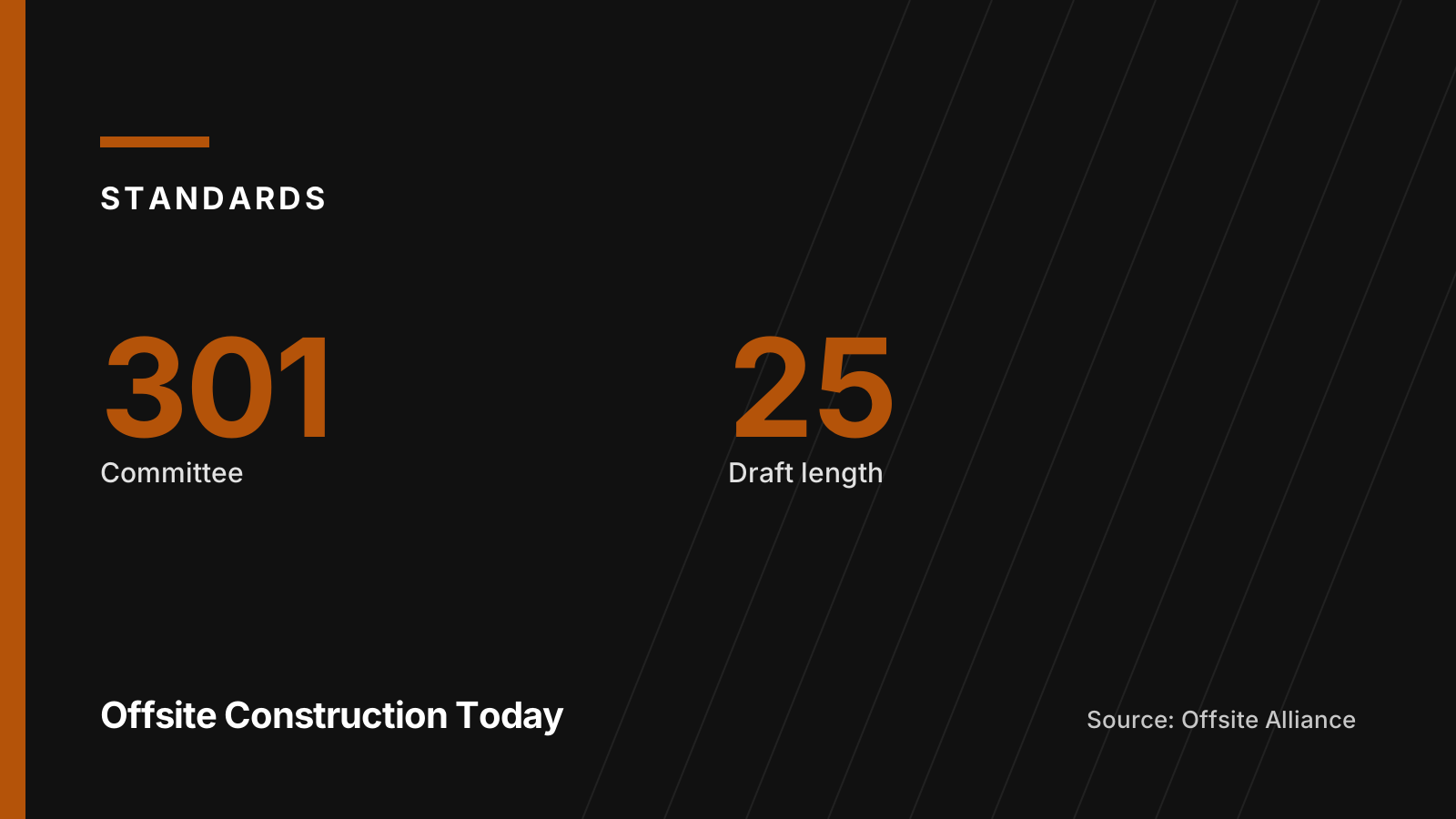
BSI committee CB/301 is seeking industry feedback on the scope of a proposed British Standard that would classify offsite and traditional construction methods by the same three questions.
The British Standards Institution (BSI) committee responsible for offsite and modern methods of construction has opened the scope of a proposed classification standard for public comment, covering every construction method from volumetric modules to brick walls laid on site.
Matt Egan, chair of BSI CB/301 Offsite and Modern Methods of Construction, set out the proposal in a post published by the Offsite Alliance. He said the first step towards the standard is a scope and brief for public feedback.
The committee is asking manufacturers, contractors, designers, lenders, insurers, warranty providers and people who build in brick and block to join the drafting panel.
Egan said the lack of a common description affects how finance and insurance treat offsite systems. "Without a common way to describe what is being built, they price the label, not the system," he said.
How the draft classifies
According to the post, the draft asks the same questions of every wall, panel and pod. The first is what the element does in the building: primary structure, enclosure, services or infill.
The second is how it is made: volumetric, panelised, component, printed, product-led, process-led or traditional. The third is how it carries load, such as a line loaded wall or a point loaded module. Material, connection and degree of completion follow.
Under this approach, Egan said, the MMC (modern methods of construction) category falls out of the answers, so the 2019 MMC Definition Framework becomes an output of the classification rather than its starting point. A traditional brick wall would be fully classified and carry no MMC category.
Product-led improvements to traditional building, such as thin joint blockwork, would be classified on the same basis, the post said.
The draft now runs to 25 pages and has gone to the CB/301 panel for review. The code format for the classification is still being drafted with the panel.
Background
The government's MMC definition framework was published by the Ministry of Housing, Communities and Local Government on 29 March 2019. It was established by a sub-group led by Mark Farmer of Cast Consultancy, chair of the wider MMC working group.
The framework identifies seven categories. Category 1 covers pre-manufactured 3D primary structural systems and Category 2 covers 2D primary structural systems. Category 6 covers traditional building product-led site labour reduction and productivity improvements, and Category 7 covers site process-led labour reduction and productivity improvements.
The 2019 document said its intention was to regularise and refine the term MMC by defining the spectrum of innovative techniques in the residential market, and to enable clients, lenders, warranty providers, building insurers and valuers to build a common understanding of the forms of MMC.
Egan said the framework's seven categories work well as a summary but give no rule for deciding which category an element belongs in, and two people can put the same system in different places.
Classification came up during the development of PAS 8700, the BSI specification for MMC published in 2025, but Egan said the thinking was not mature enough to include at that point. BSI has described PAS 8700 as the first PAS to set out comprehensive requirements and processes for deploying MMC in residential building projects.
In a separate Offsite Alliance post, Egan, writing as chair of CB/301, described the committee's consultation as focused on a standard to underpin the language used to classify and identify MMC systems. The new post says the scope covers every way of building, including traditional brick and block.
What happens next
Egan said the timing of responses matters. "Comments made now will shape the standard more than anything said once drafting starts," he said.
The post asks industry readers to review the proposed scope on the BSI project page and say whether it covers the systems they make, specify, fund or insure. Feedback and expressions of interest in joining the drafting panel go to Egan at matthew.egan@by-design.group.
On the record: BSI, Ministry of Housing, Communities and Local Government
Sources
- Offsite Alliance (opens in a new tab) (accessed 2026-11-05)
- Offsite Alliance (opens in a new tab) (accessed 2026-11-05)
- Ministry of Housing, Communities & Local Government (GOV.UK) (opens in a new tab) (accessed 2026-11-05)
- BSI (opens in a new tab) (accessed 2026-11-05)
This story was researched from the primary sources above and checked against them before publication. Spotted an error? Tell us and we will correct it promptly.